
Species library

Research in progress

Meet the Regal Jumping Spider.

Phidippus regius | Family Salticidae

A large, visually guided jumping spider native to the southeastern United States and Caribbean, with especially strong representation in Florida. This is the planned priority species, not yet the identity of an acquired ShooForge animal.

Start with the essential natural-history facts below. Identification, reproduction, husbandry context, and deeper records remain available when you want them.

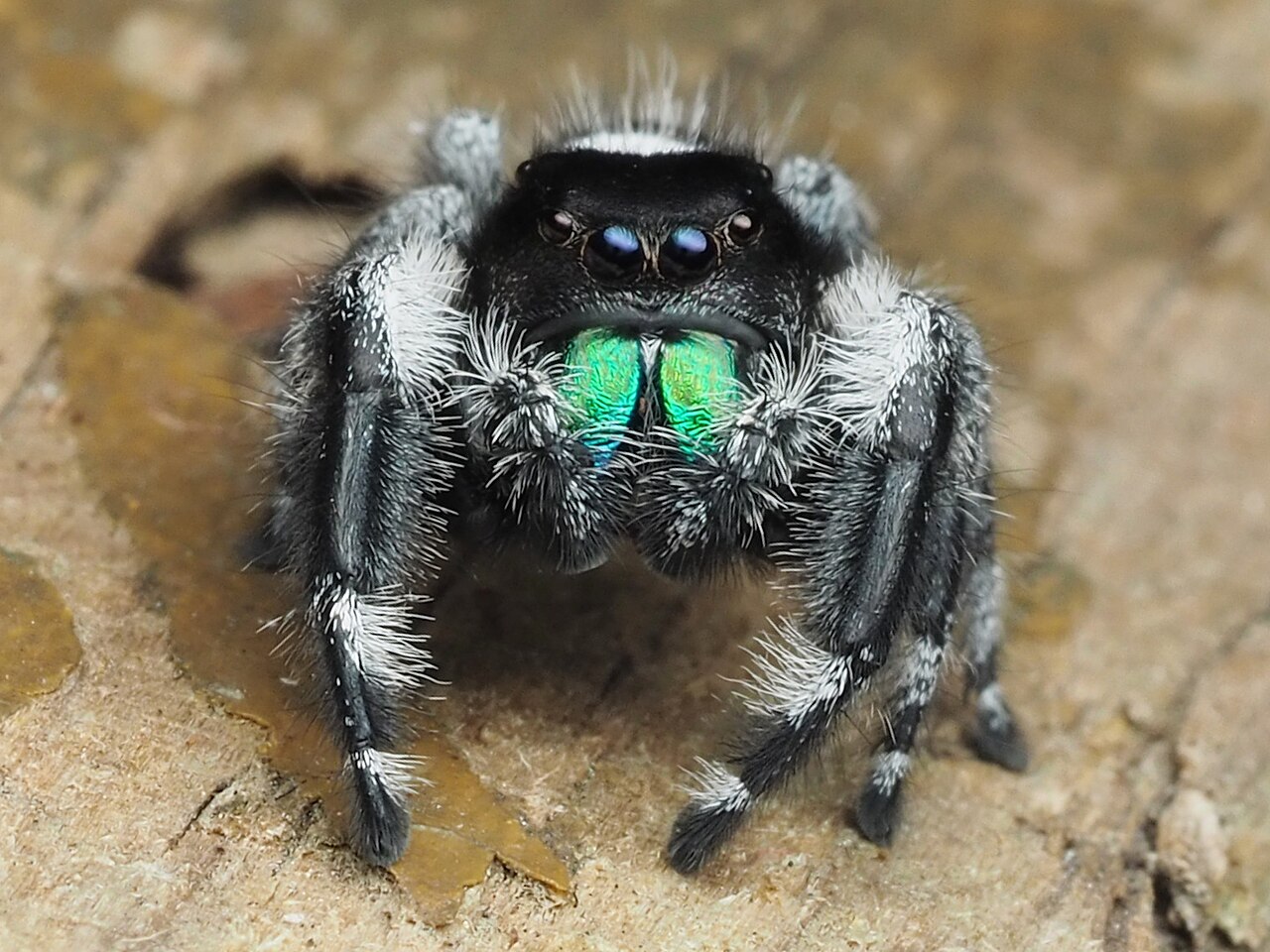
Front-facing adult male regal jumping spider with black-and-white hairs and iridescent green chelicerae.
Representative adult male Phidippus regius, not the future ShooForge mascot. Photo by spidereyes2020 via Wikimedia Commons (CC0 1.0).

Species at a glance

The essentials first.

Eight useful facts introduce the species. Each card can still be traced to its supporting references.

Native rangePublished
Southeastern United States, the Greater Antilles, and the Bahamas; especially common in peninsular Florida.
Field references (1)
Typical field habitatPublished
Fields and open woodland; older stages often use palms, palmettoes, shrubs, trees, and building walls.
Field habitat does not define a complete captive-care specification.
Field references (1)
Adult male body lengthPublished
Average 12 mm; cited range 6–18 mm.
Field references (1)
Adult female body lengthPublished
Average 15 mm; cited range 7–22 mm.
Field references (1)
AppearancePublished
A robust Phidippus with conspicuous iridescent chelicerae and sex-linked differences in color and ornamentation.
Field references (1)
ActivityPublished
A visually guided active hunter that stalks and jumps rather than waiting in a prey-catching web.
Field references (1)
Hunting behaviorPublished
Prey-specific tactics include both species-typical behavior and improvements associated with experience.
Field references (1)
Silk and retreat behaviorPublished
Uses a dragline while moving and builds ellipsoid silk retreats for night, rest, molting, and egg laying.
Field references (1)
Explore identification, reproduction, and deeper species notes (15)
TaxonomyPublished
Accepted species Phidippus regius C. L. Koch, 1846; family Salticidae.
Field references (1)
Cataloged distributionPublished
USA and Caribbean, with an introduced record on Easter Island in the current World Spider Catalog.
Field references (1)
Sexual dimorphismPublished
Adult males are black with white markings; females can carry gray, tan, brown, orange, or mixed scales.
Field references (1)
Female color variationPublished
UF/IFAS documents gray, tan, brown, orange, and mixed female scale coloration, with more colorful forms common farther south.
Field references (1)
Chelicerae colorationPublished
Iridescent in both sexes; UF/IFAS describes green-blue-violet in males and green or red-violet in females.
Field references (1)
Preferred preySource review in progress
Research in progress.
Natural diet, captive feeder preference, and nutritionally appropriate variety need separate treatment.
Temperament notesSource review in progress
Research in progress.
Friendly, curious, shy, or bold descriptions are often keeper observations and should not be converted into a universal species personality.
Captive suitabilityResearch in progress
Research in progress.
Professional care guidance exists, but a stronger species-specific welfare source set is still needed.
Field references (1)
Lifespan evidenceSource review in progress
Research in progress.
Do not publish a single captive lifespan number until sex, life stage, and source basis are clear.
Husbandry considerationsResearch in progress
Current professional guidance supports vertical space and surface hydration, but published temperature and humidity ranges remain broad, overlapping, and source-specific.
Field references (2)
ReproductionResearch in progress
Research in progress.
The UF/IFAS profile is a starting source; public copy still needs a carefully scoped synthesis.
Field references (1)
Egg sacsResearch in progress
Research in progress.
Retreat use for egg laying is sourced; clutch timing and retained-sperm guidance remain uncompiled.
Field references (1)
SpiderlingsSource review in progress
Research in progress.
Species-specific emergence, instar, and captive spiderling care remain future research.
Identification notesPublished
Eye arrangement, body form, iridescent chelicerae, abdominal markings, and sex-linked coloration are useful context, but photographs alone may not resolve every individual.
Field references (1)
Similar speciesPublished
UF/IFAS identifies Phidippus audax and Phidippus otiosus as close, similar-looking relatives across much of the range.
A future identification guide should preserve the complete key and photographic context rather than compressing it into a single spot rule.
Field references (1)

Identification boundary

Color is useful context, not a complete identification key.

Sex, maturity, variation, lighting, camera processing, and similar species can complicate visual identification. Source documentation and a knowledgeable breeder or specialist may be needed.

Before assigning a label

  • Confirm the breeder or collection record when one exists.
  • Use multiple anatomical traits and locality information rather than one color feature.
  • Keep uncertain identifications marked as uncertain in public captions and journal entries.
  • Do not infer temperament, sex, or life stage from a representative photograph.

Profile sources

Trace the species record back to its references.

Species profile references (7)
See how ShooForge labels evidence

Continue exploring

Put the species profile in context.